When balance starts to slip or legs get weaker, a mobility aid can be the difference between staying active and staying home. But walking into a medical supply store, or browsing online, brings an immediate question: should your loved one use a walker or a rollator?
They look similar, but they work very differently, and choosing the wrong one can actually increase the risk of a fall. In this guide we explain the difference in plain language, compare the benefits and drawbacks of each, and recommend specific models for different needs.
As an Amazon Associate we earn from qualifying purchases, at no extra cost to you.
How we chose: product picks are based on manufacturer specifications and long-term customer feedback. We did not receive free products. A physical therapist is the best person to recommend the right device for an individual. Read our How We Review page.
The Short Answer
- Choose a walker if your loved one needs to lean on the device for support and has significant balance problems, or is recovering from surgery.
- Choose a rollator if they can walk with reasonable balance but tire easily and want to walk farther, faster and with a place to sit and rest.
Our Recommended Models at a Glance
Our recommended models at a glance
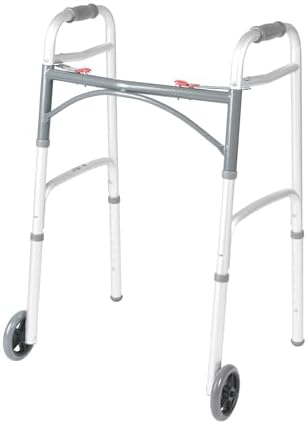
Drive Medical Two-Button Folding Walker
$27.69 on Amazon as of Oct 14, 12:31 pm ET*
- 350 lb capacity
- Only about 7.5 lb
- 5-inch front wheels
Best for: Post-surgery and poor balance
Check price on Amazon →
Drive Medical Nitro Rollator
$239.25 on Amazon as of Oct 14, 12:31 pm ET*
- 10-inch front casters
- Folds side to side
- 300 lb capacity
Best for: Outdoor walking
Check price on Amazon →
Hugo Elite Rollator
$148.00 on Amazon as of Oct 14, 12:31 pm ET*
- Padded seat with backrest
- 8-inch wheels
- Two storage bags
Best for: Frequent resting and shopping
Check price on Amazon →Three-Wheel Rollator
- Narrow and maneuverable
- Lightweight
- Easy folding
Best for: Small homes and stores
Check price on Amazon →Our rating is an editorial score based on safety, ease of use, comfort, value and verified customer feedback (see How We Review); it is not an Amazon customer rating. *Product prices and availability are accurate as of the date/time indicated and are subject to change; any price and availability information displayed on Amazon at the time of purchase will apply. As an Amazon Associate we earn from qualifying purchases.
What Is a Walker?
A standard walker is a lightweight aluminum frame with four legs and hand grips. There are two main types:
- Standard walker (no wheels): the user lifts it, moves it forward, then steps into it. It gives the most stability but is slow and tiring.
- Two-wheeled walker: front wheels and rear glides let the user push it forward without lifting. This is the most commonly recommended walker today.
Walkers are designed to carry a portion of the user's body weight. They do not roll away, which makes them safer for people with poor balance.
What Is a Rollator?
A rollator is a rolling walker with three or four larger wheels, hand brakes and usually a built-in seat and storage basket. The user pushes it along at a normal walking pace and squeezes the brakes to slow down or lock the wheels.
Rollators are designed for people who have reasonably good balance but need some support, have limited endurance or need to stop and rest. They are not designed to bear heavy weight; leaning hard on a rollator can make it roll away.
Walker vs. Rollator: Key Benefits Compared
Benefits of a walker
- Maximum stability: the frame stays put, so users can lean on it with confidence.
- Weight bearing: ideal after hip or knee surgery when weight on one leg is limited.
- Lightweight and narrow: easy to fold, lift into a car and use in small bathrooms and hallways.
- Affordable: usually much cheaper than a rollator, and often covered by insurance with a prescription.
Benefits of a rollator
- Natural walking pattern: no lifting, so users walk faster and more upright.
- Built-in seat: a place to rest whenever fatigue hits, which helps people with heart or lung conditions walk farther.
- Storage: a basket or bag carries groceries, oxygen tanks or personal items.
- Better outdoors: larger wheels handle sidewalks, grass and uneven pavement more easily.
- More social and active life: many users find a rollator lets them shop, attend events and walk the neighborhood again.
Drawbacks to know
- Walkers are slow, can feel tiring and encourage a hunched posture if set too low.
- Rollators require good hand strength and coordination to use the brakes, are heavier and bulkier, and can roll away if the user leans too much or forgets to lock the brakes before sitting.
Who Should Use Which?
| Situation | Better choice |
|---|---|
| Recovering from hip or knee surgery | Walker (usually two-wheeled) |
| Significant balance problems or frequent falls | Walker |
| Parkinson's disease with shuffling | Ask a therapist; often a specialized walker |
| COPD or heart failure with fatigue | Rollator with seat |
| Arthritis, mild instability, wants to walk outdoors | Rollator |
| Weak hands or cognitive problems using brakes | Walker |
| Tight indoor spaces | Walker or narrow rollator |
Our Recommended Models
1. Drive Medical Deluxe Two-Button Folding Walker with 5-inch Wheels (Best Walker)
This is one of the most widely used walkers in homes and hospitals. Two buttons fold it quickly, and the front wheels make it easier to push than a standard walker.
- Weight capacity: 350 lb
- Walker weight: about 7.5 lb
- Height range: 32 to 39 inches
- Width: 24 inches
- Wheels: 5-inch front wheels
Key benefits: Very light, stable and easy to fold into a car. Rear glide caps or tennis-ball-style glides help it slide smoothly indoors.
Things to consider: No seat or storage, and the small wheels are not ideal on rough outdoor surfaces.
Best for: Post-surgery recovery and people who need to lean on their mobility aid.
2. Drive Medical Nitro Rollator (Best Rollator Overall)
The Nitro is a popular European-style rollator with a sleek aluminum frame, large front casters and a comfortable seat.
- Weight capacity: 300 lb
- Rollator weight: about 18 lb
- Seat height: about 20.5 inches
- Handle height: about 33.5 to 38 inches
- Wheels: 10-inch front casters
- Folding: folds side to side with a clip to hold it closed
Key benefits: The large front wheels roll smoothly over sidewalks, curbs and thresholds, and the side-folding design stands upright for storage. A tall version is available for taller users.
Things to consider: It is heavier than a walker, and the frame is wider when open.
Best for: Active seniors who walk outdoors and want a stylish, smooth-rolling rollator.
3. Hugo Elite Rollator (Best for Comfort and Storage)
The Hugo Elite is designed with comfort in mind: a padded seat with a backrest, large wheels and generous storage.
- Weight capacity: 300 lb
- Rollator weight: about 17 lb
- Seat height: about 19.5 to 22 inches, adjustable
- Wheels: 8-inch
- Storage: under-seat bag plus a saddle bag
Key benefits: The backrest and adjustable seat height make resting more comfortable, and the storage handles a full shopping trip.
Things to consider: Like all rollators, users must lock the brakes before sitting.
Best for: People who rest often and want a comfortable seat and plenty of storage.
4. Three-Wheel Rollators (Best for Tight Spaces)
Three-wheel rollators are narrower and lighter than four-wheel models and turn more easily in tight hallways and stores. Several brands, including Drive Medical, offer them.
Key benefits: Excellent maneuverability and easy folding.
Things to consider: Less stable than four wheels, and most have no seat, so they suit people with fairly good balance.
Best for: Indoor use in small homes and busy shopping trips.
How to Fit a Walker or Rollator
- Have your loved one stand upright in their usual shoes with arms relaxed at their sides.
- Adjust the handles so they line up with the crease of the wrist.
- When holding the grips, the elbows should be slightly bent, at about 15 to 20 degrees.
- For rollators, make sure they can comfortably squeeze and lock the brakes, and that the seat height lets their feet rest flat on the floor.
Safety Tips
- Always lock rollator brakes before sitting, and never ride on a rollator while someone pushes it.
- Walk inside the frame, not behind it.
- Remove throw rugs and clutter to create clear paths at home.
- Make getting out of bed safer too. A bed assist handle gives something solid to hold before reaching for the walker; see the best bed rails for elderly adults.
- Check rubber tips, glides, wheels and brakes regularly.
- Ask a physical therapist for a short training session; it makes a real difference.
- Pair mobility aids with bathroom safety equipment such as a shower chair and with a medical alert system for people who live alone.
Helpful Accessories
A few inexpensive add-ons can make a walker or rollator safer and more practical day to day:
- Walker glides or ski glides: replace rubber back tips so a two-wheeled walker slides smoothly on carpet and tile.
- Walker trays and bags: let users carry a drink, phone or plate from the kitchen with both hands still on the grips.
- Cup holders and phone holders: keep essentials within reach, which is important for anyone who lives alone.
- Padded or ergonomic grips: reduce hand pain for people with arthritis.
- Reflective tape or a small light: improves visibility on evening walks.
Avoid hanging heavy bags from the handles of a standard walker, as the extra weight can tip it.
Ready to buy? We compare five specific models in our guide to the best rollators for seniors. And because many falls happen in the bathroom, pair any walking aid with properly installed grab bars for the bathroom.
Frequently Asked Questions
Does Medicare cover walkers and rollators?
Medicare Part B generally covers walkers and rollators as durable medical equipment when a doctor prescribes them as medically necessary and you use a Medicare-enrolled supplier. Coinsurance and deductibles apply.
Can a rollator be used as a wheelchair?
No. Rollators are not designed to be pushed with someone sitting on them. For that purpose, consider a transport chair or a specific rollator-transport chair combination.
Is it a bad sign to need a walker?
Not at all. The right mobility aid often helps people stay more active and independent, and it reduces the risk of a fall that could cause a much bigger setback.
Conclusion
Walkers and rollators solve different problems. A walker is the safer choice when your loved one needs to lean on the device, has poor balance or is recovering from surgery; the Drive Medical Two-Button Folding Walker is a light, dependable option. A rollator is better for people with reasonable balance who want to walk farther and rest along the way; the Drive Medical Nitro is our top pick for outdoor walking, while the Hugo Elite excels in comfort and storage. For tight indoor spaces, a three-wheel rollator is worth considering.
When in doubt, ask a physical therapist to assess walking and recommend the right device and height. For emotional support for families navigating changes in mobility, visit our sister site Health & Heart Caregiver.
Related Guides
Best Bed Rails for Elderly Adults: Safety-First Guide
Best Blood Pressure Monitors for Home Use (2026)
Best Medical Alert Systems for Seniors in 2026
Best Shower Chairs for Seniors: 5 Safe Picks for 2026
This article is for general information only and is not medical advice. See our Medical Disclaimer and Affiliate Disclosure.